Spring Redfish in Charleston: Why April Is When It All Clicks
Water temps are climbing, bait is flooding back inshore, and Charleston's redfish are shifting into their spring patterns. Here's what's actually happening beneath the surface — and how to put yourself on the right side of it.
There's a stretch every spring — usually somewhere between late March and mid-April — where the Charleston inshore fishery just turns on. Water that's been sitting in the low 60s finally pushes past 65, then 68, then into the low 70s. And when that happens, everything changes.
Bait that's been scarce all winter starts showing up in the creeks. Shrimp move back into the marsh. Mullet push into the shallows. And redfish — which have been hunkered in deeper channels and river bends for months — start spreading out across the flats, into the creek mouths, and along the marsh edges where they're suddenly a lot easier to reach.
If you've been waiting for the fishing to "get good," this is the month it happens. But understanding why it gets good is what separates a productive spring from a frustrating one.
What Actually Changes in April
Charleston's redfish don't migrate like tarpon or cobia. They're resident fish — they live here year-round. But their behavior shifts dramatically with water temperature, and spring is the biggest behavioral transition of the year.
In winter, reds hold in deeper water. They're in river channels, harbor edges, deep dock lines — anywhere the water retains a little thermal stability. They feed, but they're sluggish about it. Tides still matter, but the fish aren't covering much ground between meals.
Once water temps cross that 65-degree threshold, everything accelerates. Redfish metabolism spikes. They need more food, more often. They start pushing into shallower water to find it — first onto the flats adjacent to the deep winter holds, then progressively further into the creeks and marsh systems as the water continues warming.
By the time you're consistently hitting 68-72 degrees — which in Charleston usually happens somewhere in the first two weeks of April — the reds are fully committed to their spring pattern. They're up on the flats. They're in the creek mouths. They're tailing in the grass on high tides. They're feeding aggressively enough that your window of opportunity goes from narrow and technical to wide and forgiving.
That's the good news. The even better news: the bait is making the same transition at the same time.
Follow the Bait, Find the Fish
One of the most reliable patterns in all of inshore fishing is also one of the simplest: when shrimp flood back into the marsh in spring, the redfish follow them.
White shrimp start pushing into Charleston's creek systems as water temps climb through the mid-60s. By April, they're everywhere — flushing in and out of the marsh on tidal exchange, stacking up in creek mouths on outgoing water, holding along grass edges on incoming. If you can find concentrations of shrimp, you are standing next to redfish. That's not a theory — that's just how it works.
Finger mullet make a similar move. They show up in the shallows as the water warms, and once they do, they become a primary forage target. Redfish pushing across a flat will blow up on mullet schools in a way that's honestly hard to miss — you'll see the water erupt, bait spraying in every direction, and bronze-colored flashes underneath.
The tactical takeaway: in April, your lure selection should match what the redfish are eating. And what they're eating is small — 2 to 4 inch shrimp and finger mullet. This is not the time for oversized baits.
A paddle tail swimbait in the 4-inch range is about as versatile as it gets for spring reds. Something like the Z-Man DieZel MinnowZ on a 1/4-ounce jighead lets you cover water efficiently, stays in the strike zone, and the ElaZtech material floats when you pause it — which gives you that hang-and-wiggle action that reds can't leave alone. Rig it weedless on a wide-gap hook when you're working oyster edges or thick grass, and you'll stop losing lures to the bottom.
Tides Are Everything (But Not How You Think)
Ask five anglers when the best tide is for redfish and you'll get five different answers. The real answer is that the best tide depends entirely on what kind of water you're fishing. And in spring, understanding this matters more than any other time of year — because the fish are actively moving between zones as the tide shifts.
Here's the framework:
Incoming tide pushes water (and bait) up into the marsh, flooding flats that were dry an hour ago. Redfish follow that water in. This is when you'll find fish tailing in ankle-deep grass, nosing along spartina edges, and cruising flooded flats that they couldn't access at low water. If you like sight fishing — watching for tails, wakes, and pushes — incoming tide on a spring flat is as good as it gets in Charleston.
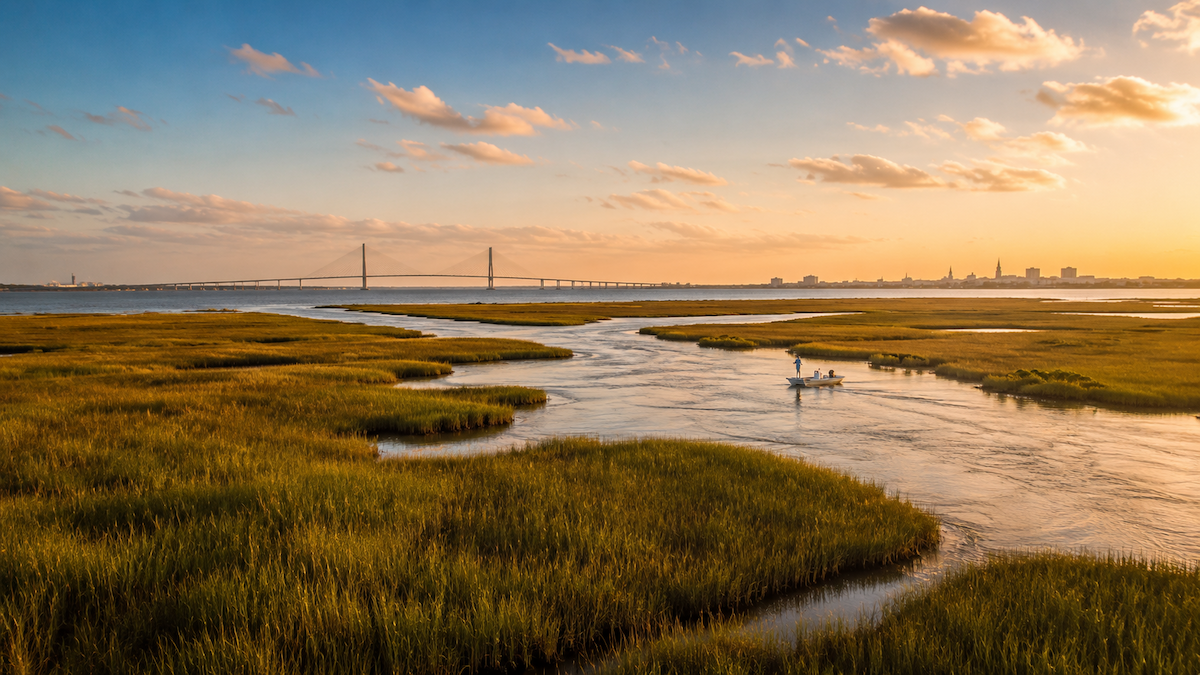
Outgoing tide pulls all of that water back out, funneling it through creek mouths, drain points, and cuts in the marsh. Bait that spread out across the flat during high water now has to exit through a handful of narrow openings. Redfish know this. They stage at those exit points like toll collectors, picking off shrimp and mullet as the water drains. Creek mouths on an outgoing spring tide are some of the most productive setups in all of Lowcountry fishing.
Slack water — the period right around dead high or dead low — is generally the slowest window. Water isn't moving, bait isn't being concentrated anywhere, and the fish tend to hold and wait for the next push. It's not dead fishing, but if you have a choice, fish the movement.
The key insight: you don't need to fish the entire tide cycle. You need to be in the right type of water for the right stage of the tide. Flats on the incoming. Creek mouths and drain points on the outgoing. If you can time those two windows and position yourself correctly, you'll put fish in the boat.
Which, pardon us plugging our own shit here, is exactly why we built MarshMind. The AI processes tide stage, water temperature, wind, bait patterns, and a pile of other variables to tell you which zones are firing right now — not in general, not on average, but at this specific moment on this specific tide. But even without the app, understanding the tide-to-habitat relationship above will make you a better redfish angler immediately.
Wind Matters More Than You Think
April in Charleston usually brings light to moderate south and southwest winds. This is generally a good thing — south wind pushes warmer water inshore, stabilizes surface temps, and creates comfortable drift conditions on the flats.
But when the wind blows harder — 12-15+ mph — it changes the game. Exposed flats get choppy and murky, which pushes both bait and fish into more protected water. On windy spring days, your best play is to focus on lee-side shorelines, sheltered creeks, and any water that's blocked from the prevailing wind direction. The fish don't stop eating when the wind blows — they just relocate to calmer water.
Light wind days (under 10 mph) are a gift. That's when the full flat system opens up, the water stays clear enough for sight fishing, and you can drift or wade without fighting the conditions. If you see a light-wind morning in the forecast during April, clear your schedule.
The Gear That Actually Matters
You don't need a $400 rod and a tackle box full of boutique lures to catch spring redfish. You need a handful of presentations that cover the situations you're likely to encounter, and the discipline to match your approach to the conditions.
Paddle tail swimbaits are the workhorse. A 4-inch swimbait on a 1/4-ounce jighead covers 80% of spring redfish situations — blind casting flats, working creek mouth edges, bouncing along oyster transitions. Natural colors (white, bone, green back) in clear water. Darker colors (root beer, dark shrimp) in stained water.
Weedless gold spoons are the other 20%. When you're fishing over thick grass, oyster bars, or shallow flats where a jighead would foul instantly, a Johnson Silver Minnow in gold does what it's done for decades — rides over structure, throws flash, and catches redfish. Keep your rod tip up, retrieve slow enough that it wobbles without spinning, and you're in business. It's not fancy. It doesn't need to be.
For days when the bite is slow or the water is cold and muddy after a front — and April in Charleston will give you at least a couple of those — a scented soft plastic like Berkley Gulp! Saltwater Shrimp on a light jighead can be the difference between a zero and a solid day. The scent dispersal genuinely matters when fish are relying more on smell than sight. Bounce it slow along the bottom near structure and give it time to work.
Pressure Is Real — Even in Spring
Here's something nobody writes about in fishing articles: fishing pressure affects where and when redfish feed. Charleston's inshore fishery gets hammered on weekends, especially at well-known spots. Boat traffic, kayak traffic, wade fishermen — it all pushes fish off predictable patterns.
Spring amplifies this because the weather is perfect and everybody's on the water. The spots that fished well on a quiet Tuesday morning might be a ghost town by Saturday at 10 AM.
The fix isn't complicated: fish early, fish weekdays when you can, and don't overlook the less obvious zones. The creek mouth that everybody drives past to get to the famous flat might be holding more fish than the famous flat. The dock line in a no-name tidal creek might be stacked with reds that haven't seen a lure in weeks.
Charleston has an enormous amount of fishable inshore water. Most anglers fish the same 10% of it. The other 90% is where the unpressured fish live.
The Bottom Line
Spring redfish in Charleston isn't about any single trick or magic lure. It's about understanding the transition that's happening — warming water, returning bait, expanding range — and positioning yourself to take advantage of it. Match the tide to the habitat. Follow the bait. Keep your presentations natural and appropriately sized. And get out there early in April, because this is genuinely the best window of the year for inshore reds.
The fish are moving. The water is warming. The bait is back. Go put one on the deck.
---
MarshMind's AI tracks every variable that moves Charleston redfish — water temperature, tide stage, wind, bait patterns, barometric pressure, and more — scoring every inshore zone in real time so you know exactly where to go. Start free →
 charleston
 Charleston fishing
 charleston fishing