Pier Season Is Waking Up: What Mount Pleasant and Folly Tournaments Say About the Spring Bite
Charleston’s Cast Off Fishing Tournament season opens at Mount Pleasant Pier and Folly Beach Pier this May, right as warming water and spring bait movement start changing the inshore picture. Here’s what pier season says about the broader Charleston bite without turning it into a spot-by-spot playbook.
Charleston pier season has a way of sneaking up on people.
One week everybody is still talking about cold fronts, dirty water, and whether spring has really settled in yet. Then the calendar flips, bait starts moving a little harder, the water warms, and suddenly the piers start feeling alive again.
This May, Charleston County’s Cast Off Fishing Tournament season opens with two local dates: Mount Pleasant Pier on Saturday, May 9, followed by Folly Beach Pier on Saturday, May 16. Both tournaments run 6 a.m. to 2 p.m., with registration handled on-site the morning of each event.
That is good news for pier anglers, but it also says something bigger about the spring bite around Charleston.
The inshore system is starting to shift.
Pier fishing is a good spring signal
Pier fishing gets treated like its own separate world sometimes.
Boat anglers talk about creeks, docks, flats, jetties, and grass lines. Pier anglers talk about rail space, bait buckets, wind direction, tide swing, and whether the guy beside them is casting sideways like he has unpaid parking tickets.
But the fish do not care what platform you are standing on.
The same seasonal changes affecting Charleston’s creeks, surf lines, harbor edges, and bridge structure are also showing up around the piers. Warming water, longer days, more bait movement, and stronger spring tides all start changing what feels realistic.
That does not mean every species magically turns on at once. It means the menu gets wider.
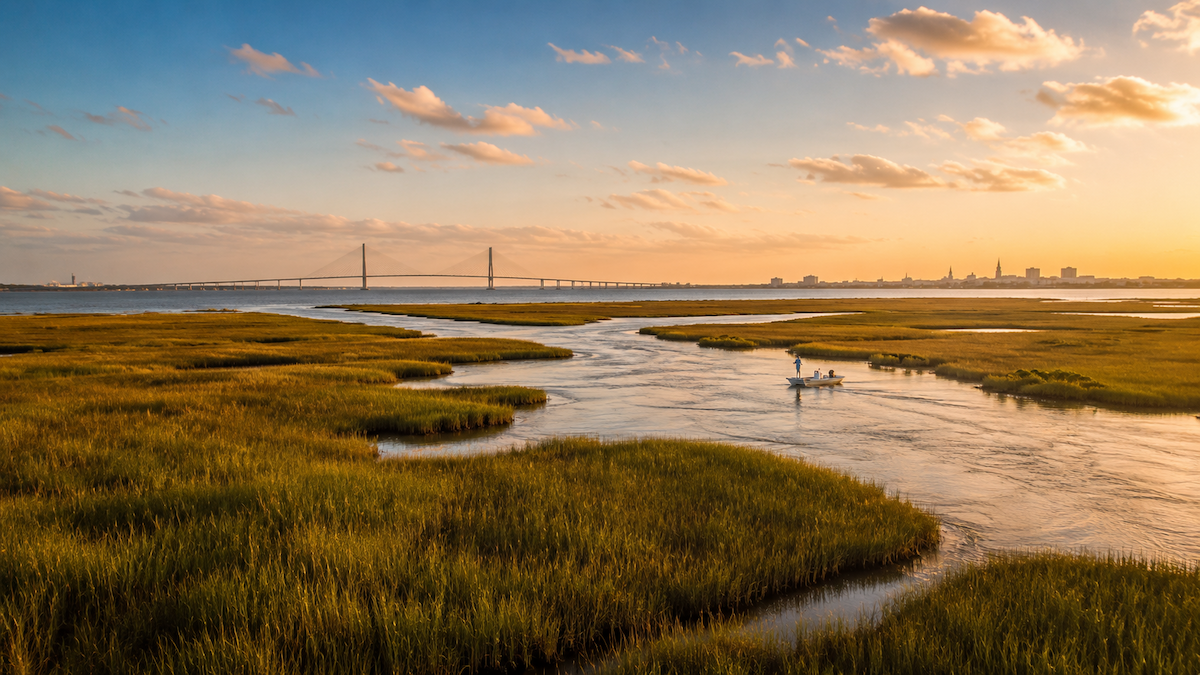
Mount Pleasant Pier sits in Charleston Harbor under the Ravenel Bridge, and Charleston County Parks notes that the old Silas N. Pearman Bridge pilings have become fish habitat for species like red drum, spotted seatrout, flounder, and sheepshead. Folly Beach Pier stretches 1,045 feet into the ocean, where common catches include bluefish, sheepshead, spotted seatrout, and whiting.
Two piers. Two different water types. Same bigger message:
Spring is waking up.
The bite is not one pattern anymore
Winter fishing around Charleston can feel narrow. Pick your windows, watch the cold fronts, slow down, and hope the water gives you enough stability to work with.
Spring is different.
By May, the bite starts spreading across more types of water. Pier edges, bridge structure, surf lines, docks, creek mouths, shell, and deeper current breaks all begin telling different stories.
That is where people get crossed up.
They hear one report and try to make it apply everywhere.
Someone catches fish off a pier, so they assume everything inshore is firing. Someone has a tough morning on a flat, so they assume the bite is dead. Somebody posts a cooler shot, and half the town starts acting like the same thing should happen anywhere with water.
Charleston does not work that cleanly.
The spring bite is more like a split-screen. One piece of water can be warming up and full of life while another is still awkward, muddy, windy, or just not lined up right.
That is why pier tournaments are useful as a local signal, but not the full answer.
They show the season is moving. They do not tell you exactly how your water is reading today.
Mount Pleasant and Folly are not saying the same thing
Mount Pleasant Pier and Folly Beach Pier are both public fishing staples, but they do not read the same.
Mount Pleasant is more harbor, bridge, current, and structure.
Folly is more ocean-facing, surf-influenced, and beach-pier oriented.
That matters.
A fish showing up around Folly does not mean the same thing as a fish showing up under the Ravenel Bridge. A clean morning at Mount Pleasant does not mean Folly’s water is doing the same thing. Wind, tide, clarity, bait, current direction, and bottom type can make those two places feel like completely different planets on the same day.
That is the real lesson for anglers.
Location matters, but context matters more.
A pier is not just a pier. A dock is not just a dock. A grass line is not just a grass line.
Every piece of water has a job only when the conditions let it do that job.
Spring gives anglers more options — and more ways to guess wrong
This is the part of spring that trips people up.
More species are possible. More areas look alive. More reports start coming in. More bait shows up. The water feels better. Everybody gets a little more confident.
And somehow, that can make decision-making worse.
Because when everything feels possible, people start chasing everything.
One hour thinking trout. Next hour looking for redfish. Then a sheepshead thought creeps in. Then somebody says flounder are showing. Then the wind shifts. Then the tide stage changes. Now you are halfway through the day with six half-plans and no real read.
Pier season is a good reminder to simplify.
Do not ask, “What can bite in Charleston right now?”
Ask, “What is this specific water set up to do today?”
That is the better question.
Tournaments are fun, but the real value is the read
The Cast Off tournaments are built for all experience levels. Charleston County Parks says prize categories include Biggest 3 Fish by Weight, Biggest Youth Catch, and Best 5 Fish Total Weight, with no preregistration required.
That kind of event is good for the local fishing community. It gets families out. It gives newer anglers a reason to show up. It makes pier fishing feel social instead of solitary. And honestly, there is something very Charleston about a mixed crowd of serious regulars, kids with shrimp, tourists, and one guy with twelve rods who knows exactly what he is doing.
But from a fishing intelligence perspective, tournaments also create a snapshot.
They show what a specific pier, under specific conditions, during a specific window, was able to produce.
That is useful.
But it is still just one read.
The better move is taking that local signal and stacking it with the rest of the picture: tide, wind, water temperature, season, structure, access style, and species behavior.
That is where the guessing starts to shrink.
What pier season says about Charleston right now
The big takeaway is not “go fish a pier.”
It is that Charleston is entering the part of spring where the water starts offering more options.
Structure becomes more interesting. Surf-adjacent water gets more attention. Harbor edges start changing character. Bait movement starts mattering more. Species variety begins to widen. And anglers who keep reading the water instead of chasing noise usually make better decisions.
That applies whether you are standing on Folly Pier, fishing under the Ravenel, drifting a creek edge, working a dock line, or trying to decide if the wind has ruined your original plan.
May does not hand out easy answers.
It gives clues.
Bottom line
The Mount Pleasant and Folly Cast Off tournaments are a clean local marker that Charleston’s spring fishing season is moving into a new gear.
Not summer yet. Not winter anymore.
Somewhere in the middle — where the bite is widening, the water is changing, and the best call depends less on old reports and more on what the conditions are saying right now.
That is the whole game.
The pier crowd will get their shot this month.
The rest of us should be paying attention too.
 charleston
 Charleston fishing
 charleston fishing